 跳到内容
跳到内容 
Core Industrial Heat Exchangers
Select plate, shell & tube, spiral, and storage-type exchangers by duty, media, and maintenance needs.
Industrial Heat Exchangers
Select plate, shell & tube, spiral, and storage-type exchangers by duty, media, and maintenance needs.
Why Choose Teplaron Heat Exchangers
Engineering-led selection, buildable designs, and documentation you can run with.
1. Engineering-led sizing based on your duty, media, fouling, and allowable pressure drop.
2. Service-friendly configurations that consider cleaning, access, and downtime.
3. Material and gasket options selected for corrosion, temperature, and compatibility.
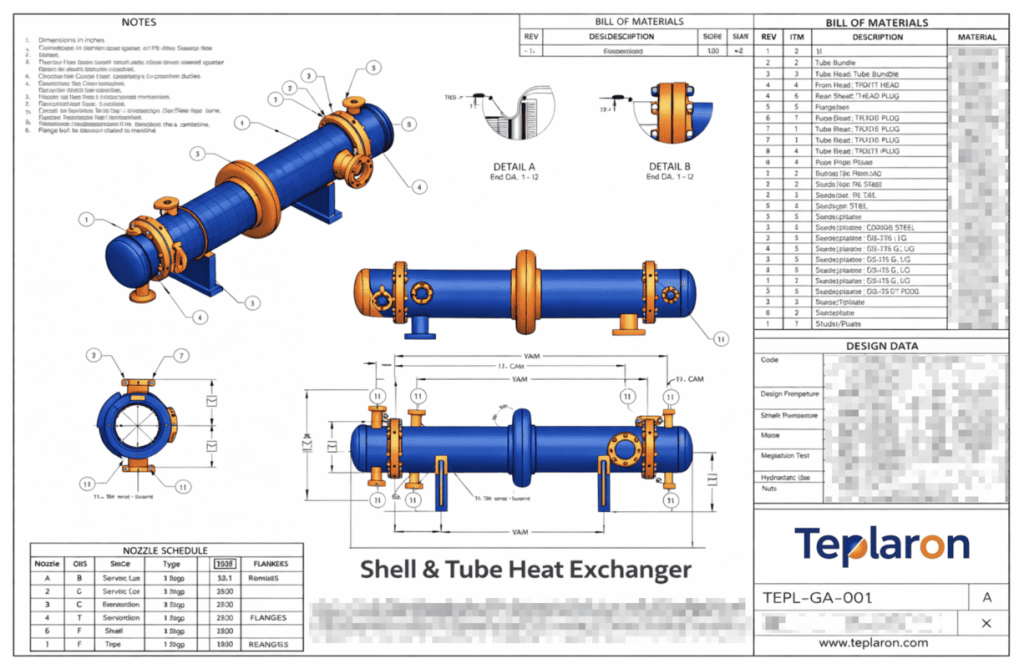
4. Clear GA drawings and connection schedules for faster installation coordination.
5. Testing and documentation packages available as required (pressure/leak, records, inspection).
6. Responsive quoting with technical feedback and next steps.

Heat Exchanger Series
Browse turnkey system series and start from the one that matches your duty.
Gasketed Plate Heat Exchanger
Compact, high efficiency for clean to moderately fouling fluids; easy to expand.
- High efficiency with a compact footprint
- Easy to open, clean, and expand capacity
Shell-and-Tube Heat Exchanger
Robust for higher pressure/temperature and tougher media; wide material options.
- Built for higher pressure/temperature duties
- Serviceable design for tougher media and maintenance
Storage-Type Heat Exchanger
Buffering + heat exchange for intermittent loads and stable outlet temperature.
- Thermal buffering for intermittent or peak loads
- Stable outlet temperature with reduced cycling
District Heating Heat Exchanger
Optimized for heating networks, substations, and continuous service duty.
- Optimized for district heating networks and substations
- Stable performance under variable loads and continuous duty
Spiral Wound Tube Heat Exchanger
Excellent for fouling or viscous fluids with single-channel flow and easier cleaning.
- Compact solution for demanding pressure/temperature service
- Robust tube bundle for reliable long-term operation
Vertical Floating Coil Heat Exchanger
A vertical coil exchanger with a floating bundle design for thermal expansion tolerance and service-friendly maintenance.
- Floating coil bundle accommodates thermal expansion
- Vertical layout saves space and improves service access
How to Select a Heat Exchanger
Match duty and constraints to the right exchanger type in four quick checks.
1. Need compact size and high efficiency for clean to moderately fouling fluids? → Choose Plate.
2. Higher pressure/temperature or tougher media? → Choose Shell-and-Tube.
3. Fouling, solids, or viscous media with cleaning priority? → Choose Spiral.
4. Intermittent loads or buffering required for stable outlet temperature? → Choose Storage-Type.
Plate
Compact efficiency
Shell-and-Tube
High P/T duty
Spiral
Fouling-ready
Storage-Type
Load buffering
Operating Envelope
Define limits for temperature, pressure, materials, and connections before selection.
Temperature
Depends on exchanger type and material selection. Share your duty to confirm limits.
- °C / °F
- Approach
- Media
Pressure
Varies by series, size, and code requirement. We size for duty and allowable ΔP.
- Design Pressure
- ΔP
- Duty
Materials
Material and sealing options selected for corrosion, temperature, and compatibility.
- SS / Ti / Alloy
- Gasket
- Lining
Connections
Flanged, threaded, or welded ends available to match your piping standard.
- DIN / ANSI / JIS
- Flange
- Thread / Weld
Scope of Supply
Deliverables structured for engineering review, installation, and commissioning.
Engineering Package
- Selection datasheet (duty, media, approach, allowable ΔP)
- GA drawing and connection schedule
- Installation and operation guidance
- Spare parts recommendation (if required)
Quality Package
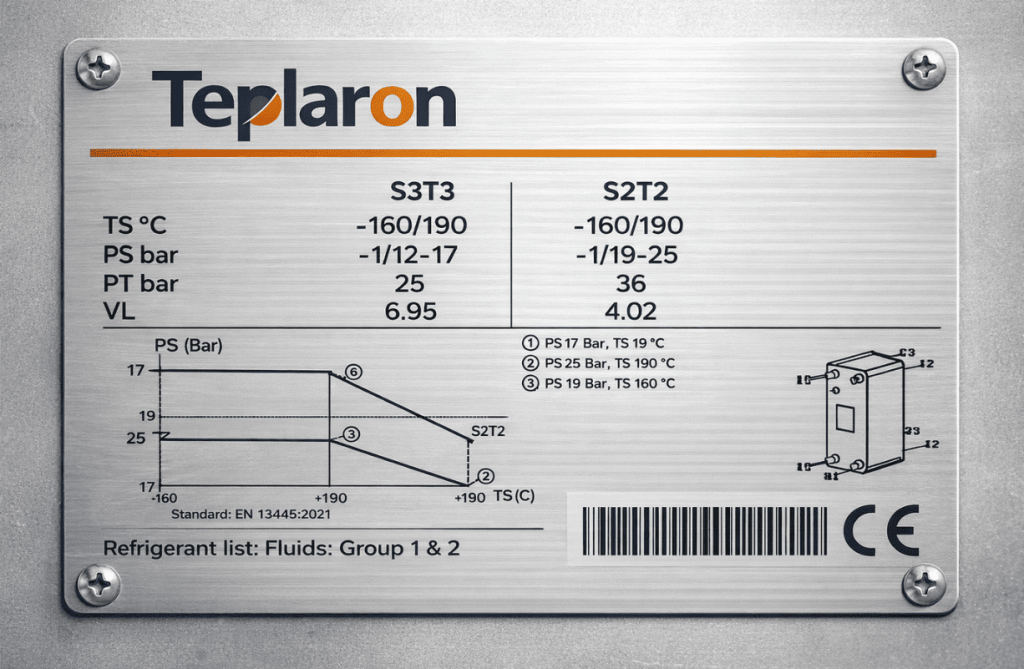
- Material certificates available as required
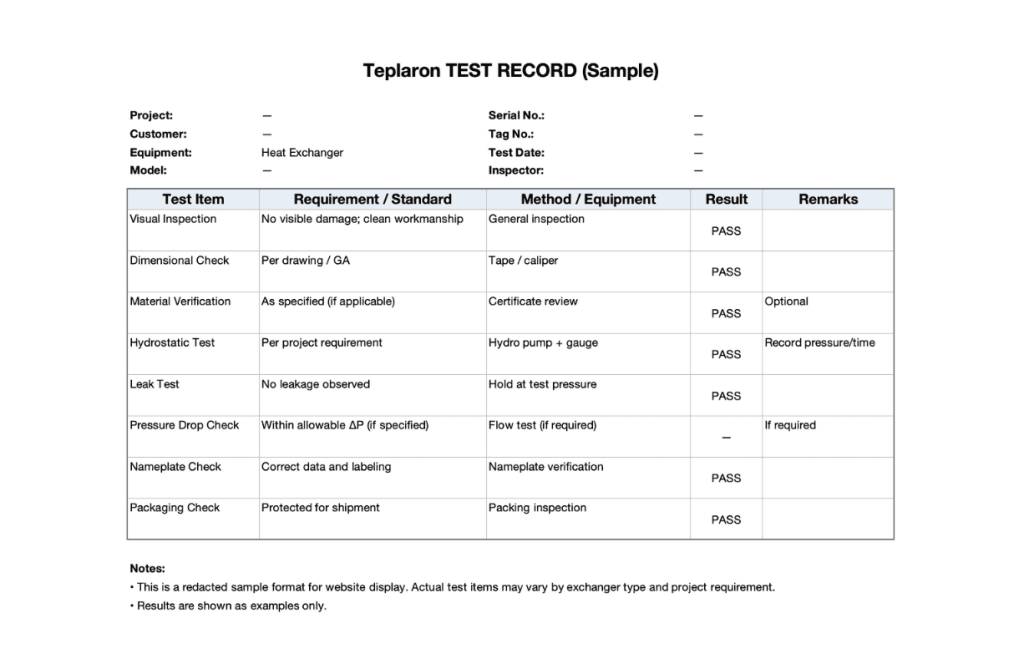
- Pressure / leak test records (by exchanger type)
- Inspection checklist and photo records (if required)
- Packing list and shipping documents
Quality & Testing
Practical QA steps and test options aligned with your project requirements.
Build
Verification
Fit-up and assembly checks to ensure buildable dimensions and correct connections.
Material
Review
Material certificates and key specs can be provided based on project requirements.
Pressure
Leak Testing
Hydrostatic or leak testing options depending on exchanger type and acceptance criteria.
Inspection
Checklist
Standard checklists to confirm labeling, workmanship, and completeness before shipment.
Documentation
Package
Test records and handover documents prepared for engineering review and site use.
Third-Party
Inspection
Third-party inspection can be coordinated when required by the project.
Testing scope may vary by exchanger type, code, and customer specification.
From Duty to Delivery
A clear workflow from process inputs to selection, drawings, production, and shipment.
Collect Process
Inputs
Confirm media, flow, temperatures, and key constraints (ΔP, materials, standards).
Sizing & Type
Selection
Run thermal sizing and recommend the best-fit exchanger type and configuration for your duty.
Technical
Alignment
Lock scope: materials, connections, ΔP, fouling assumptions, and documentation needs.
Quotation &
Lead Time
Provide quotation and schedule based on confirmed scope and quantity.
GA
Drawing
Prepare GA and connection schedule for layout review and installation coordination.
Production &
Assembly
Build to the confirmed configuration with controlled fabrication and assembly steps.
Final QA &
Release
Complete final checks and release the unit for shipment per agreed requirements.
Packing &
Dispatch
Pack, label, and dispatch with the required shipping and handover package.
Sizing Requirements
Share your duty and constraints for accurate sizing and best-fit selection.
Thermal Data
- Heat source: steam / hot water / thermal oil (pressure, temperature)
- Load side fluid and concentration (water / glycol, etc.)
- Flow rate (or heat duty)
- Inlet / outlet temperatures (target) and allowable ΔP
- Fouling, solids, and cleaning method (CIP / manual)
Site & Controls
- Installation space / footprint limits
- Connection standard, size, and orientation (if fixed)
- Power supply and control signals (PLC/HMI & I/O)
- Operation mode: attended / unattended / remote-ready
- Local standards or special requirements (if any)
Start Your Sizing Request
Share your duty and constraints—we’ll recommend the right system configuration.
Share your duty and constraints—we’ll recommend the right system configuration.
What you’ll receive
1. Recommended configuration & key components
2. Interface notes and next-step questions
3. Proposal basis for approval
Click the button below to open the full spec form—upload your duty, constraints, and any specs, P&ID, or photos.
Quick Thermal Design Request
Send what you have—partial data is OK. We’ll confirm the rest by email.
Send what you have—partial data is OK. We’ll confirm the rest by email.
FAQ
Common questions about selection, materials, testing, and delivery—answered.
How do I choose the right heat exchanger type?
Start from four checks: efficiency/compactness, pressure & temperature, fouling/solids, and buffering needs. Share your duty and constraints—we’ll recommend the best-fit type. Start a sizing request →
What information do you need for sizing?
Media, flow rates (or duty), inlet/outlet temperatures, allowable ΔP, and fouling/cleaning method. Partial data is OK—we’ll follow up to confirm the rest. Send what you have—start a sizing request →
Can you handle fouling, solids, or viscous fluids?
Yes. Selection depends on fouling level, solids content, viscosity, and cleaning preference (CIP/manual). Send your media details and we’ll recommend the most suitable type.
What materials and standards are available?
Material options are selected based on corrosion compatibility, temperature, and local standards. Connections can be aligned to common standards (DIN/ANSI/JIS) as required.
What testing do you provide?
Testing scope depends on exchanger type and project requirements. Typical options include pressure/leak testing and inspection records as required.
What’s included in the scope of supply?
Typical deliverables include a selection datasheet, GA drawing (if required), test records (as required), and packing/shipping documents.
How fast can you respond to a sizing request?
For complete duty inputs, we typically respond within 1–3 working days. Complex duties or special requirements may take longer, and we’ll confirm after review. Submit your duty now →
Do you support installation and commissioning?
We provide installation guidance and interface notes. If you have site constraints, share them early so we can align layout and connections.
